
By Kashish Agarwal
---
Citation: [1892] EWCA Civ 1, [1893] 1 QB 256
Act:
Principle: If a person fulfils the conditions in an open offer made to the public at large, this will constitute a valid agreement.
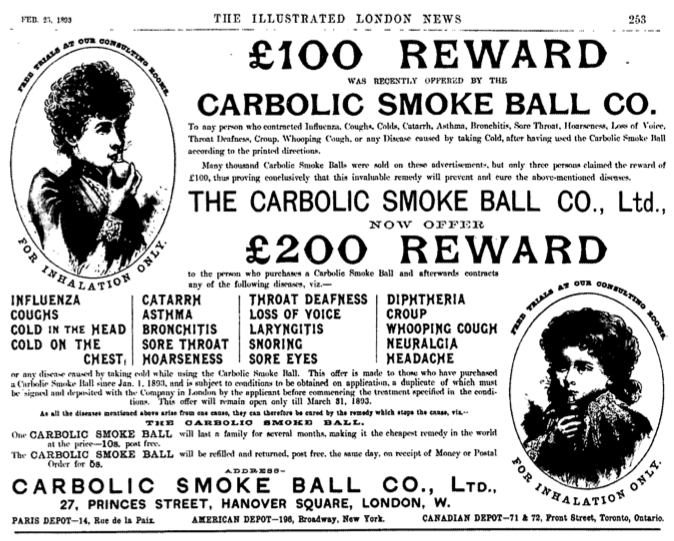
the second advertisement
Formation of contracts via promises made in advertisements has always been an issue. When companies make promises through advertisements, they are making offers to the world at large. Breach of such claims can open a floodgate of lawsuits, and therefore, companies aim to avoid them. In Carlill versus Carbolic Smoke Ball Company Co., the English Courts upheld legal responsibility in cases of breach of general offers such as these.
Facts
The company made a product called
“Smoke Ball” during the Influenza pandemic of 1889-1890. The Company published
advertisements in several newspapers on 13 November 1891, claiming that it
would pay £100 to anyone who got sick with influenza after using its product
according to the instructions set out in the advertisement. The plaintiff,
Louisa Carlill, believing in the accuracy of the statement, purchased the
product and used it as per the instructions given by the company. Despite this,
she had an attack of Influenza.
Thereupon, her husband wrote a letter
for her to the defendants, stating what had happened, and asking for £100 as
promised in the advertisement. They refused and this action was brought in
court before Hawkins J. and a special jury. The decision was given in favour of
the plaintiffs following which, the defendants appealed to the higher
authority. The defendants raised several contentions in their favour, primary
amongst which were:
a)
The
advertisement did not constitute a contract because the offer wasn’t made to
anyone in particular.
b)
A
binding contract did not exist because acceptance wasn’t notified to the
company.
c)
The
advertisement was not lucid enough. Important terms and conditions were left
out and the advertisement was too vague to constitute a promise.
d)
The
advertisement was Nudum Pactum. There was no consideration on part of the
plaintiffs and therefore, a contract could not have said to exist.
Decision
The decision was given in favour of the
plaintiffs and two primary judgements were given by Lindley, L.J and Bowen,
L.J.
Lindley, L.J
The first contention was disposed by
stating that the offer was made to the public in general and can be performed
by anyone by fulfilling the conditions in the advertisement. Anyone who fulfils
these conditions accepts the offer and a contract can therefore, be created.
In response to the second argument the
judge said that in cases such as these, it is apprehended that they are an
exception to the rule that the notification of the acceptance should precede
the performance. This offer is a continuing offer. It was never revoked, and if
notice of acceptance is required, then the person who makes the offer gets the
notice of acceptance contemporaneously with his notice of the performance of
the condition before his offer is revoked.
The
judge further clarified that the conditions which were not specified have to be
deduced on a reasonable basis. The reasonable interpretations of all conditions
which were not specified all work in favour of the plaintiff and therefore, the
third contention was also rejected.
The
fourth argument was also rejected by the judge by saying that there was a
consideration on part of the plaintiff by the way of performance. The
plaintiff, by following the instructions given in the advertisement put herself
through distinct inconvenience which would be sufficient to constitute
consideration under the law. Further, Lord Lindley stated that the
advertisement of the ‘smoke balls’ increased the confidence of the general
public in their product and increased their sales. The transaction, therefore,
resulted in an advantage to the company which was enough to constitute
consideration. Therefore, the presence of consideration was accepted by the
judge.
Bowen,
L.J.
The
judge ruled in favour of the plaintiffs, and in order to contend the arguments
made by the defendants, he relied on the common-sense construction of the
advertisement and the intention of the advertisers. The vagueness of the
document of advertisement can be overcome by reading it plainly as a common
man. This led him to rule in favour of the plaintiffs. The defendants also
argued that the advertisement was a mere puff and the defendants did not intend
to enter into a contractual agreement. However, the judge rejected this
argument by saying that the advertisement was written in such a manner that it
was intended to be understood by public as an offer to be acted upon.
Herein,
the judge made a important remark in response to the argument that it would be
difficult to check the genuine claims and considering such claims as
contractual obligations would be unreasonable. He said that when someone makes
an extravagant promise, he does the same in expectation of some profit. When he
has made such promises, despite their unreasonableness, they are enough to
create an obligation in law.
He also distinguished cases of advertisements like these from
invitation to offer. In this case, there is no scope for negotiation such as in
case of advertisement for books to sell or houses to let, where advertisements
do not constitute an offer but an invitation to negotiate. He cited Spencer v. Harding in which Lord Willes
ruled that if there is an offer to be bound on a condition, then there is a
contract the moment the acceptor fulfils the condition.
Lord Bowen accepted that it is necessary for the person to
whom the offer is made to follow the indicated method of acceptance. And if the
person making the offer expressly or impliedly intimates in his offer that it
will be sufficient to act on the proposal without communicating acceptance of
it to himself, and the offer is one which in its character dispenses with
notification of the acceptance, then the performance of the condition is a
sufficient acceptance without notification. The act of ascertainment of the
nature of contract as such which dispenses with the requirement of acceptance
can be done by looking at the offer. The nature of advertisements is such that
the acceptor does not have to notify his acceptance before performance, and
performance dispenses the need of notification of acceptance. The advertisement
is to be read in the light of common-sense, and upon doing this, it can be seen
that In their offer the company impliedly indicates that they do not require
notification of the acceptance of the offer
It was therefore ruled that, in case of promises made through
the medium of advertisements, contracts can be formed by performance and
recovery is possible in case of breach of such a contract.

the first advertisement
---
Kashish Agarwal is a second year student at National Law University, Delhi. Being a law student, she loves to keep up with the legal affairs in the country and abroad. Apart from this, she spends her time adding to the seemingly endless list of movies she has watched.
No comments:
Post a Comment